

Description
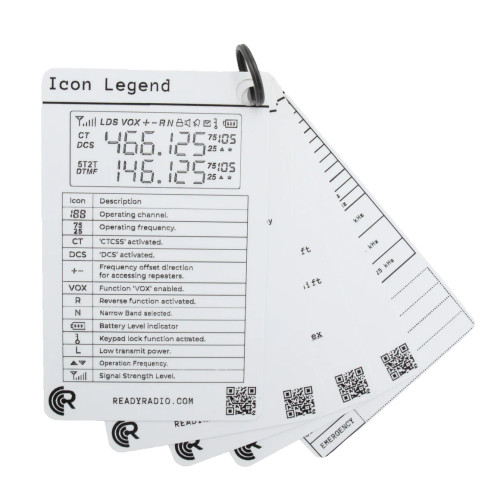
Most people buy a radio and learn the buttons. Almost nobody learns how to actually run comms, the procedures, reporting formats, and net discipline that separate an organized team from a handful of people talking over each other when it counts. That knowledge usually lives inside military and professional training. These cards put it in your pocket. Fourteen credit-card-sized references covering the tactical communication procedures that turn a group with radios into a functioning comms network.
This is a different set from our radio reference cards. Those teach you how radio works, channels, tones, band plans, propagation. This set teaches you how to operate: how to run and join a directed net, how to build a comms plan that survives contact with reality, and how to pass a clear report when you're stressed and the clock is running. It's the operator discipline, not the radio theory.
Everything on the cards is the real, standardized format, not a simplified version. You get net control and check-in procedures for running or joining a directed radio net. PACE communications planning (primary, alternate, contingency, emergency) so your group always has a fallback. SITREP format for organized situation reports and SALUTE for reporting observed activity. The 9-Line MEDEVAC format and MIST casualty reporting for medical emergencies. Standard radio prowords, message handling and precedence, the NATO phonetic alphabet and number pronunciation, UTC/Zulu time with US time-zone conversions, antenna and range fundamentals, distress and emergency procedures, and radio regulations and OPSEC reminders. There's also a fill-in communications plan card for writing down your call signs, PACE options, rally points, and check-in times so your whole team is literally on the same page.
Each card is credit-card sized (3.375" × 2.125"), built to ride in a wallet, admin pouch, radio pouch, vehicle console, or go-bag, and they come on a keyring so they stay attached to your gear. No phone, no signal, no bulky manual. Pair them with our Radio Reference Guide for the radio-knowledge side and the Comms Cards for your specific radio's programming, and you've covered how radio works, how your radio works, and how to operate as a team. Build a complete setup with the Radio Kit Builder.
How This Set Fits With Our Other Cards
We make a few reference sets, and they're built to work together rather than overlap. The Tactical Comms Reference Cards (this set) cover procedures and reporting, how to operate as a team. The Radio Reference Guide and Mini Reference Cards cover radio knowledge, frequencies, bands, tones, and propagation. The Comms Cards and Programming Cards are radio-specific, showing the button layout and setup for your exact model. A serious operator ends up with all three types: the theory, the machine, and the procedure.
What's Covered
- Net control and check-in procedures for running and joining a directed net
- PACE communications planning (primary, alternate, contingency, emergency)
- SITREP format for clear, organized situation reports
- SALUTE reports for communicating observed activity
- 9-Line MEDEVAC format with patient, location, and pickup-site fields
- MIST casualty reporting for organized patient handoffs
- Standard radio prowords for clear, efficient traffic
- Message handling and precedence for recording and prioritizing traffic
- NATO phonetic alphabet and number pronunciation
- UTC/Zulu time with US time-zone conversions
- Antenna and range fundamentals
- Distress and emergency procedures
- Radio regulations and OPSEC reminders
- Fill-in communications plan card for call signs, PACE, rally points, and check-in times
Who It's For
Anyone who needs to coordinate people over the radio, not just talk on it. Preparedness and emergency comms groups, tactical and field radio operators, GMRS and amateur operators, CERT and volunteer organizations, search and rescue teams, security and response personnel, off-road and overland groups, and anyone training up new operators. If you've ever been in a situation where nobody knew who was in charge of the net or how to pass a report, this set is the fix.
Specs
- Cards: 14-card set
- Size: 3.375" × 2.125" (credit-card size)
- Binding: Keyring included
- Focus: Tactical comms procedures and reporting formats (radio-agnostic)
- Power required: None. No app, no signal, no manual.
What's Included
- (1) set of Tactical Comms Reference Cards (14 cards)
- (1) keyring
FAQ
How is this different from your other reference cards?
This set covers procedures, how to operate as a team: net control, PACE planning, SITREP, 9-Line MEDEVAC, prowords, and OPSEC. Our Radio Reference Guide and Mini cards cover radio knowledge (frequencies, bands, tones), and our Comms Cards are specific to your radio's buttons and setup. This is the operator-discipline set.
Are these made for a specific radio?
No. Nothing here is model-specific. These procedures and formats apply to any radio and any group, whether you run GMRS, amateur, or tactical radios. They're about how you operate, not which radio you own.
Do I need a military background to use these?
No, and that's the point. These formats come from professional and military comms, but the cards lay them out plainly so a preparedness group, SAR team, or new operator can pick them up and use them. No prior training required.
What is PACE and why is it here?
PACE stands for Primary, Alternate, Contingency, Emergency, a framework for building a comms plan with layered fallbacks so your team isn't stranded if the primary channel fails. The set includes a fill-in card so you can write out your group's actual plan.
Can I use these for group training?
Yes. They're a great teaching tool for getting a whole group speaking the same procedural language, running a net, passing reports, and following a comms plan the same way. Many groups buy sets for every member.
Are they a substitute for real training?
No. These are informational field references, not a replacement for professional medical, emergency-response, or radio-licensing training. They're there to jog your memory and standardize your team's procedures, not to certify you.