
Posted by Defense Distributors on Oct 21st 2026
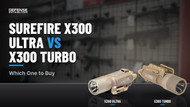
SureFire X300 Ultra vs X300 Turbo: Which One to Buy
The X300 Ultra and X300 Turbo are both proven pistol lights, but they solve different aiming and identification problems. If you buy by lumen number alone, you can end up with the wrong beam for your actual distances. The right choice comes from your environment, your expected photonic barriers, and your acceptable tradeoffs in spill versus reach.
Here is the short version. The Ultra is usually better for tight indoor work and broad visual information at common defensive distances. The Turbo is usually better when you need candela to push through ambient light, smoke, street lighting, and reflective clutter. Both mount the same way and both are durable enough for serious use, so the beam profile is the deciding factor.
Start With Beam Shape, Not Marketing Claims
Lumens describe total light output. Candela describes intensity in the hotspot. You do not need a physics lecture to use that correctly, but you do need to tie each number to a real task: seeing across a room, identifying hands in a parking lot, or reading detail around a vehicle at distance.
A higher-lumen light with lower candela usually gives you more spill. That can make navigation and room context easier because you get more peripheral illumination. A lower-lumen light with much higher candela concentrates energy into a tighter core, which helps you keep useful illumination farther out and through competing light sources.
This is why people argue past each other on the X300 question. One shooter is solving home-interior unknowns with short sight lines, and another is solving distance and light pollution outdoors. Both can be right for their own use case while giving opposite buying advice.
What the X300 Ultra Does Better
The Ultra tends to feel easier in structures because the beam gives you a broader working picture at short range. In hallways, stair transitions, and room entries, that wider spill can reduce the amount of over-aiming required just to understand what is around your focal point. If your expected problems happen mostly inside, this matters every time you press the switch.
The Ultra also tends to be friendlier when working around white walls and light-colored interiors. You still have to manage splashback and avoid self-blinding techniques, but the beam is generally less tunnel-like than high-candela options. For many users, that translates to faster interpretation of shapes and movement at ordinary home distances.
If that profile matches your reality, the SureFire X300 Ultra Handgun Light is the straightforward pick. It gives up long-range punch compared with the Turbo, but it can be the more useful tool when context and spill are the priority over max throw.

What the X300 Turbo Does Better
The Turbo is the answer when your problem is maintaining useful illumination farther out or through photonic barriers. Street lights, vehicle headlights, reflective glass, and mixed-shadow parking lots can wash out lower-intensity beams. Higher candela gives you a stronger center that holds target detail when the environment is working against you.
That matters for people who spend significant time outside at night, around vehicles, or on larger properties where shots and identification distances can stretch beyond typical indoor ranges. You are not buying extra reach because it sounds cool. You are buying it because your visual problem actually starts at longer distance.
The tradeoff is a tighter beam with less forgiving spill. You can still run it indoors, but your technique matters more because the hotspot focus can make close work feel less broad. If your priority is dominating light competition and keeping definition at distance, the SureFire X300 Turbo Handgun Light is usually the better tool.
The Practical Tradeoffs Most Buyers Miss
First, people confuse seeing a bright wall with seeing a person clearly. A wall can look very bright while a target area still lacks detail because intensity is not landing where you need it. Candela solves that more directly than raw lumen count when range and competing light increase.
Second, technique can hide or exaggerate differences. If your support-hand index and momentary activation are inconsistent, both lights will seem worse than they are. Before blaming gear, run simple repetitions at known distances and compare what details you can actually identify, not what looks dramatic in photos.
Third, your optic and irons setup affects how fast the beam information turns into a shot decision. If your presentation is late or your index is loose, the broader spill of the Ultra may feel easier. If your index is strong and your workload includes distance or exterior transitions, the Turbo's intensity advantage shows up quickly.
How to Decide in One Range Session
Set up three stations: 7 yards indoor-equivalent, 15 yards mixed-light, and 25 yards low-light with background clutter if your facility allows it. Use the same pistol and ammo with each light, and keep the drill sequence identical. Do not switch multiple variables at once.
At each distance, record three outcomes: how fast you can identify a specific target feature, how confidently you can track hands through movement, and whether spill gives useful context around the focal point. Write results immediately after each string so memory bias does not distort your comparison later.
If you repeatedly lose detail at 15 to 25 yards or in bright ambient spill, the Turbo is likely your answer. If your strongest improvement is short-range context and faster interpretation inside structure-like lanes, the Ultra is probably the better purchase. The decision should come from observed performance, not internet consensus.
Direct Recommendation by Use Case
Choose the Ultra if your highest-probability use is inside a home, apartment, or similarly confined interior where broad context and forgiving spill matter most. Choose the Turbo if your realistic use includes exterior spaces, vehicles, or longer identification problems where candela is the controlling variable. Both are good lights, but only one is best for your actual terrain.
For the distance-first profile, the Turbo's intensity is the reason to buy it. The SureFire X300 Turbo Handgun Light is not a universal upgrade over the Ultra, but it is the better answer when light competition and range are your real constraints.

What To Do Next
Pick your primary environment first, then buy the beam profile that solves that environment. If you can test both, run the same short drill at 7, 15, and 25 yards and keep written notes on detail recognition and context. Make the decision from your own data and lock in one setup you will actually train with.
If your environment changes seasonally or by assignment, build a secondary plan now. That can mean owning both lights or choosing one and adjusting your tactics around its strengths and limits. The wrong answer is pretending both beams perform the same once distance and ambient light start to matter.