

Posted by Defense Distributors on Sep 23rd 2026
Baofeng BF-F8HP Review: Is 8 Watts Actually Worth It?
Most people looking at the BF-F8HP are asking one question: does the jump to 8-watt transmit power change anything that matters in the real world. The short answer is that power helps in some edge cases, but it does not rescue bad antenna setup, poor frequency planning, or sloppy radio procedure. If you are buying this radio as a complete solution by itself, you will probably be disappointed.
The better way to evaluate the BF-F8HP is as part of a handheld comms setup. You need to look at what band you are using, what antenna is on the radio, what terrain is between stations, and whether everyone in your group is programmed the same way. Once you frame it that way, the radio makes more sense.
What 8 Watts Changes and What It Does Not
Transmit power is only one part of the link budget. Going from roughly 4 to 8 watts is a 3 dB increase, which is real but not dramatic. In plain terms, that is a modest bump, not a doubling of practical range in most terrain.
If your current handheld setup fails because of buildings, ridgelines, heavy tree cover, or poor antenna placement on the receiving side, adding a few dB at the transmitter often does not fix the core issue. UHF and VHF still care about line of sight. The signal still has to get around physical obstacles, and a handheld at chest height is a compromised antenna position from the start.
Where extra power can help is in marginal situations where comms are almost readable already. If you are clipping in and out with noise, a small improvement in signal-to-noise ratio can make voice copy cleaner. That matters for short, time-sensitive messages where repeating traffic wastes time.
Where the BF-F8HP Is a Legit Upgrade
The BF-F8HP makes sense for users who already run disciplined comms and want a little more transmit margin without moving to a larger radio class. It is especially useful when your team is working simple simplex plans and everyone has similar handhelds. In that context, consistency often beats chasing specs.
If you are coming from an older entry-level handheld and you want a current, familiar form factor, the Baofeng BF-F8HP Dual Band Handheld Radio is a reasonable pick. You are not buying miracles, but you are getting a known platform with broad accessory compatibility and straightforward programming workflow.
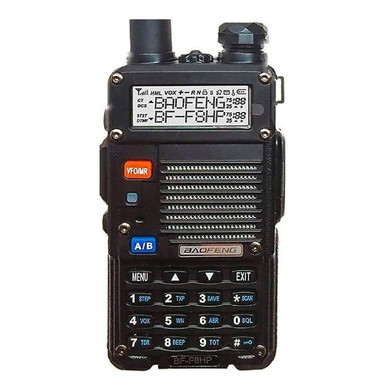
The upgrade case is weaker if you expect a handheld to replace fixed antennas, elevated positions, or repeaters. Power cannot compensate for bad geometry. If your current pain point is coverage into structures or across terrain breaks, put effort into your comms plan first.
Battery management also matters more at higher output settings. More transmit power generally means faster battery drain during active use. If your operating periods are long or you run frequent check-ins, power accessories may affect mission durability more than the difference between two radio models.
The Antenna Usually Matters More Than the Wattage Label
Stock rubber duck antennas are convenient, but they are compromise components. For many users, antenna choice produces a bigger practical improvement than jumping between nearby handheld wattage classes. Better antenna efficiency and tuning can improve both transmit and receive performance.
A straightforward option is the Covert Flexible Antenna for Baofeng Radios. It is easy to pack, less awkward than long whips in tight spaces, and gives you a better starting point than many factory antennas when you are trying to keep comms reliable without changing the entire setup.

Before you assume your radio is weak, test from controlled positions. Stand still, hold the radio vertical, and run short readability checks on known frequencies at known distances. Change one variable at a time, such as antenna, location, or power setting, then log what actually changed.
This process gives you actionable data instead of forum folklore. You will quickly see whether your bottleneck is transmission strength, receive noise floor, antenna mismatch, or terrain shadowing. Once you know that, buying decisions get cheaper and faster.
Programming and Net Discipline Decide Whether the Radio Works
A lot of handheld comms failures come from bad programming hygiene, not hardware limits. If channels are inconsistent across users, tone settings do not match, or simplex naming is unclear, your team will waste time troubleshooting under stress. That defeats the point of having radios in the first place.
The easiest way to keep radios aligned is to standardize a channel plan file and load it consistently. The Baofeng Programming Cable is the practical tool that enables that workflow for BF-F8HP users and keeps channel maps from drifting between units.

A basic operating procedure helps more than people expect. Define primary, alternate, and emergency channels. Use brief check-ins at set intervals. Require read-backs for critical traffic. If a call is missed, wait a few seconds and retry with the same wording before changing channels.
These habits reduce confusion and conserve battery because people stop long, repeated transmissions. They also make after-action troubleshooting possible, since everyone can identify whether the issue was coverage, congestion, or user error.
Should You Buy the BF-F8HP
If you already understand your comms environment and want a little more transmit headroom in a familiar handheld format, the BF-F8HP is worth consideration. If you are expecting a dramatic range jump by power rating alone, it is probably not the upgrade you think it is.
A realistic order of operations is simple: first clean up programming and procedure, then test with a better antenna, then decide whether the power increase solves a measured problem. This keeps your budget focused on bottlenecks you can prove. It also gives you a repeatable process for future radio purchases.
Next step: run a controlled field check with your current setup this week, document where comms degrade, and only then decide if the BF-F8HP fills that exact gap. That single test will tell you more than another month of spec-sheet comparisons.