
Posted by Defense Distributors on Nov 10th 2026
AR-15 Buffer Weights Explained: Carbine vs H vs H2 vs H3
The buffer is the part of your AR-15 most people never think about until something goes wrong. It sits in the receiver extension behind the bolt carrier, and its weight controls how fast the carrier moves when the rifle cycles. Change the weight and you change how the gun feels and how reliably it runs.
Most buffers look identical from the outside. The difference is what's inside.
What's Inside Each Buffer
A carbine buffer holds three internal weights. Swapping steel weights for tungsten ones, which are much denser, is what makes an H, H2 or H3. The length stays the same, so all four fit a standard carbine tube with a standard carbine spring.
| Buffer | Internal weights | Typical weight |
|---|---|---|
| Carbine | 3 steel | about 3.0 oz |
| H (also called H1) | 1 tungsten, 2 steel | about 3.8 oz |
| H2 | 2 tungsten, 1 steel | about 4.6 to 4.7 oz |
| H3 | 3 tungsten | about 5.4 to 5.6 oz |
Exact weights vary a little by manufacturer. Rifle-length buffers and proprietary systems like the VLTOR A5 are different lengths and don't follow this chart.
What a Heavier Buffer Actually Does
A heavier buffer slows the bolt carrier down. That delays unlocking slightly and softens how hard the carrier slams into the back of the tube. On the right rifle the result is a smoother recoil impulse, less muzzle movement and less wear on parts.
It's most useful on rifles that run with more gas than they need:
- Short barrels. A 10.3" or 11.5" barrel has its gas port close to the chamber, so it sees higher pressure. These are classic H2 and H3 candidates.
- Suppressed rifles. A suppressor pushes extra gas back into the action. A rifle that runs fine unsuppressed can turn violent with a can on it.
- Hot ammo. Heavier, higher-pressure loads cycle harder than cheap range ammo.
When Heavier Is the Wrong Move
Too much buffer weight causes its own problems. If the carrier doesn't travel far enough back, the rifle can short-stroke, fail to eject, or fail to lock the bolt open on an empty magazine. This shows up most with weak or underpowered ammo, and it's worse in cold weather.
A buffer won't fix a rifle with a gas problem, either. An undersized gas port, a misaligned gas block or a leaking gas key needs to be fixed at the source. And if you shoot a lot of different ammo, suppressed and unsuppressed, an adjustable gas block gives you more control than any single buffer weight.
How to Tell What Your Rifle Needs
Start with the lock-back test. Load a single round of the weakest ammo you plan to shoot, fire it, and confirm the bolt locks open. Do it several times. If it won't lock back reliably, your buffer is too heavy for that ammo.
Ejection pattern is a second clue. Picture a clock above the rifle with the muzzle at 12. Brass landing around 3 to 4:30 is the range most people consider normal. Sources disagree on exactly what a pattern outside that means, so don't tune from ejection alone. Use it alongside the lock-back test and how the rifle feels.
As a rough starting point, many 14.5" and 16" carbines run well on an H or H2. Short barrels and suppressed guns usually end up at H2 or H3. Treat that as a starting point and test your own rifle.
Our Picks

The Geissele Super 42 combo pairs a braided-wire spring with an H2 buffer. The braided spring removes most of the "sproing" you hear through the stock and gives about 15% more average return force than a standard carbine spring. It's a common upgrade for 14.5" and 16" rifles that feel harsher than they should, and for suppressed carbines.

Step up to the H3 version for short barrels and rifles that run suppressed most of the time.
Two things to know about the Super 42. The spring and buffer are designed as a matched set, and the spring won't fit over a standard buffer, so don't mix them with other brands. Geissele also doesn't recommend it for 300 Blackout subsonic loads, which may not have enough energy to cycle against it.
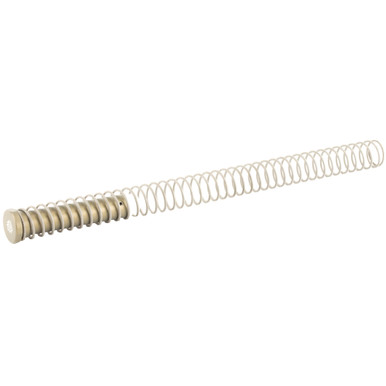
The VLTOR A5 is a different system altogether. It uses a longer buffer and spring that won't work in a standard carbine tube. The kit includes a 5.3 oz A5 buffer, the A5 spring, an end plate and a castle nut. You'll also need the VLTOR RE-A5 receiver extension, which is sold separately. It's a good choice if you're building a rifle from scratch and want a smoother-cycling system from the start.
See everything we carry in Buffers and Springs.
The Short Version
If your rifle runs reliably and feels fine, you don't need to change anything. If it feels harsh, beats up brass, or runs violent with a suppressor, try a heavier buffer and confirm it still locks back on your weakest ammo. If you're building a short-barrel rifle like our 10.3 CQB setup, plan on an H2 or heavier from the start. For help choosing a barrel length, see what length AR-15 barrel to run.